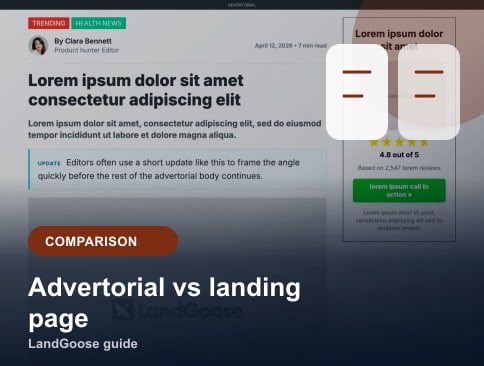
An advertorial is promotional content written in an editorial style. It explains a problem, story, product, or offer before guiding the reader toward a commercial action. Unlike a conventional landing page, it earns attention through useful article-like content while remaining clear about its promotional purpose.
Quick Answer
An advertorial is a sales page written in an editorial format, but the useful ones do more than hide a pitch inside an article. They help a cold visitor understand the problem, the context, the product, and the next step before asking for a click.
Use one when the buyer needs a little education before the offer makes sense. Skip it when the product is obvious, the visitor is already warm, or the page cannot add anything beyond a thin rewrite of the product description.
Advertorials sit in the middle of content and promotion. They look and read like useful editorial content, but their job is still commercial: move the reader closer to a purchase, signup, or click-through. That mix is exactly why advertorials still work so well for affiliates, ecommerce brands, and performance marketers.
If you have ever wondered what an advertorial actually is, when to use one, and what separates a convincing advertorial from a page that feels fake, this guide will give you the practical answer.
What Is an Advertorial?
An advertorial is a promotional page written in an editorial style. Instead of opening with a hard sales pitch, it introduces a problem, tells a story, builds trust, explains the product or offer, and then leads the reader toward an action.
Good advertorials do not hide the fact that they are trying to sell something. They simply do a better job of warming up the reader before the click. That is why they often outperform direct product pages for cold traffic.
How Advertorials Work
The best advertorials follow a simple flow:
- earn the scroll with a strong headline, lead, and first visual
- introduce a problem, opportunity, or curiosity gap
- tell a story or create a reason to keep reading
- present the product or offer as the solution
- add proof, testimonials, or before/after process detail
- end with a clear call-to-action
That structure is why advertorials feel more persuasive than a standard product block. The reader is not dropped directly into a “buy now” page. They are moved there in sequence.
Why Advertorials Beat Generic Product Pages for Cold Traffic
Cold visitors usually land with two immediate questions: why should they trust this store, and why should they believe this solution is better than the other options they have already seen? A thin product page rarely answers both well.
A strong advertorial does. It gives you room to explain the problem, show why common fixes disappoint, and build belief around your product before asking for the next click.
Advertorial vs Landing Page vs Blog Post
These formats overlap, but they do different jobs:
- Advertorial: editorial-style persuasion page designed to pre-sell and warm up traffic
- Landing page: a broader conversion page that may be direct, short-form, and more obviously transactional
- Blog post: usually informational first, often with softer commercial intent
Advertorials are especially useful when your traffic is cold, skeptical, or not ready to buy after a single headline and product image.
3 Common Advertorial Examples
Most advertorials fall into a few familiar structures:
- The story advertorial: a personal journey, founder story, or “I found this after trying everything” angle
- The review advertorial: a breakdown of why a product stands out, often with pros, cons, and proof
- The comparison advertorial: a side-by-side approach that frames alternatives before presenting a preferred choice
If you want more structure ideas, see our related guide on advertorial examples.
Pros of Using Advertorials
- they give cold traffic more context before the sale
- they create room for story, proof, and product explanation
- they make it easier to test different angles against the same offer
- they often improve click quality going into checkout or the next step
Cons of Using Advertorials
- they take more effort than a short direct-response landing page
- weak advertorials become long and boring very quickly
- without a clear CTA, readers can consume the content and leave
- they require stronger alignment between hook, story, and offer
In other words, the format is useful, but it still needs structure. A long page is not automatically a good advertorial.
Start With Research, Not the First Draft
The best advertorials are built from real customer language, not guesswork. Before writing, pull phrases and objections from sources like product reviews, Reddit threads, comments, competitor ads, and support questions.
A practical way to organize that research is to sort it into buckets such as:
- pain points and frustrations
- desired outcomes
- specific situations where the problem shows up
- failed alternatives people already tried
- objections that stop them from buying
That research gives you better hooks, stronger proof, and much more believable copy.
Tips for Writing a Better Advertorial
- treat the headline, lead, and first image as the most important part of the page
- lead with one specific angle instead of a vague promise
- write for one reader and one problem at a time
- show why common alternatives fail before you reveal your product
- use proof early enough to keep the claim believable
- make the CTA feel like the natural next step, not a jump cut
- keep the page easy to scan on mobile
If you want a full checklist, read what makes a good advertorial.
When Should You Use an Advertorial?
Use an advertorial when you need more room to explain, persuade, and pre-sell before the conversion. That is especially true for:
- health, beauty, and supplement offers
- problem-aware but skeptical buyers
- ecommerce products that benefit from story and demonstration
- affiliate campaigns where angle testing matters
For ecommerce-specific guidance, see advertorials for ecommerce.
Next Steps
If you want to go deeper, read what makes a good advertorial, browse our advertorial examples, or follow the full workflow in how to build an advertorial page.
Continue with the right next step


7 Benefits of Advertorials for Ecommerce and Performance Marketing