Test an advertorial when shoppers need a specific explanation before they can evaluate your product. Start with the product page when the ad already gives them enough context to choose. Judge both routes by purchases and acquisition cost across the complete journey, not by the conversion rate of the people who reach your store.
Your ad attracts people who have never bought from you. Should the click go straight to the product, or should an article explain the offer first?
An advertorial gives you more room to develop the ad's promise. It also adds a page load and another decision to continue. A product page removes that extra step, but it still needs to answer the questions your ad creates.
The useful question is not which format is universally better. It is what the shopper needs to understand before buying, and where you can explain it most clearly.
Advertorial vs Product Page at a Glance
An advertorial is advertising presented in an article format. A product detail page, or PDP, presents a particular product and the information and controls needed to purchase it. Both can educate, show evidence and sell. An advertorial can itself be the landing page for an ad; these are not mutually exclusive categories.
| Decision | Advertorial before the product page | Direct to the product page |
|---|---|---|
| First task | Develop one question or buying consideration | Help the visitor evaluate and select the product |
| Typical opening | An explanation tied to the ad's angle | Product name, image, price and key benefit |
| Useful content | Demonstrations, context, buying criteria and objections | Features, variants, demonstrations, delivery and returns |
| Next action | Continue to the specific product or offer | Select an option and add to cart |
| Main risk | Extra reading and navigation without useful information | Asking for a purchase before answering the ad's question |
| What decides the test | Outcomes across the entire route | Outcomes across the entire route |
For broader definitions, see advertorial vs landing page. This guide focuses on choosing the destination for a product campaign.
The Same Product in Two Page Formats
Consider a fictional adjustable-fill pillow. In this demonstration, it has a removable cover and filling that can be removed to change its height. The example is not a real brand, customer testimonial or performance case study.
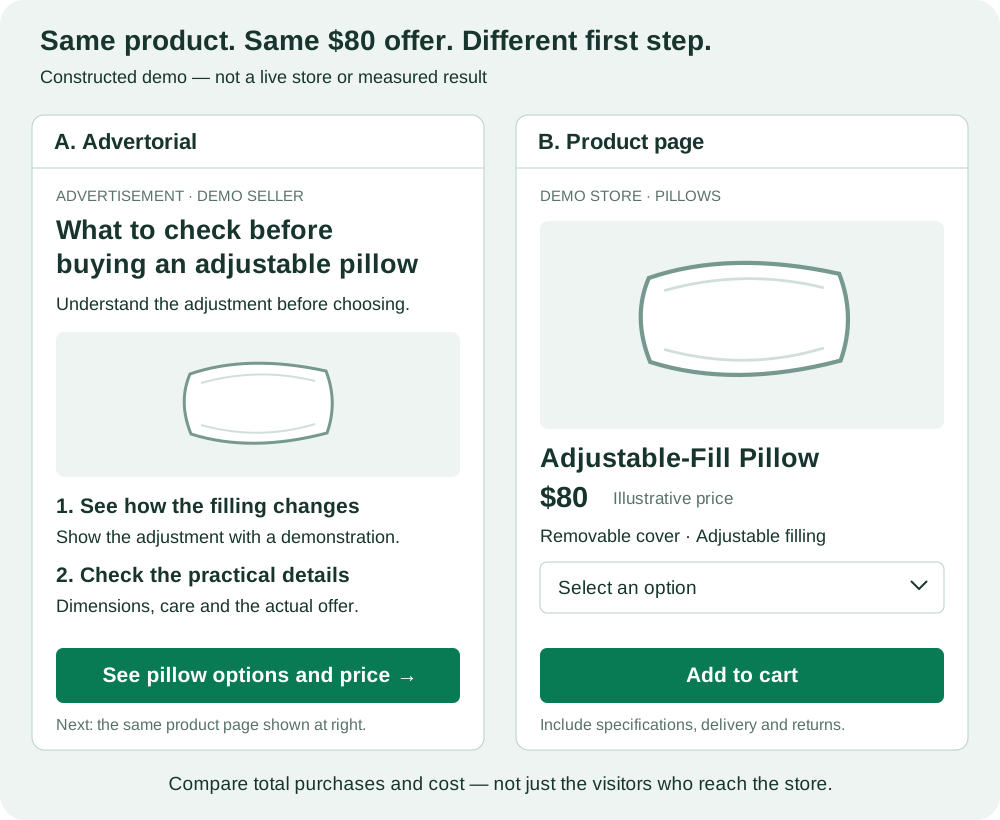
Both routes receive an ad showing the filling being removed. Both offer the same product for an illustrative $80. The difference is what the visitor sees after the click.
Route A: The Ad Goes Straight to the Product
The product page opens with “Adjustable-Fill Pillow,” a clear product image, the $80 price and an option selector. A short clip demonstrates removing the filling. Dimensions, care instructions and the actual delivery and returns terms sit near the buying controls.
This route could be sufficient if the ad already demonstrated the adjustment and the visitor mainly wants to check the price and specifications. The page does not need to be a bare catalog listing: it can include the explanation next to the product.
Route B: The Ad Goes to an Advertorial First
The advertorial opens with “What to Check Before Buying an Adjustable Pillow.” It explains how the adjustment works, what changing the filling does to the setup, and which dimensions and care requirements to check. It then introduces the fictional product and links to the same $80 offer.
This is worth testing if customer questions suggest that the adjustment is unfamiliar or difficult to evaluate. It is less useful if it simply repeats the ad and makes people scroll through generic sleep advice.
Use a visible advertising label and identify the seller. An article layout should not imply independent reporting. Product demonstrations and verified specifications are useful evidence; invented doctors, reviews and health outcomes are not.
Browse advertorial examples for more page structures. Once you choose a route, our Facebook Ads to Shopify advertorial funnel guide covers connecting the ad, page and CTA.
When an Advertorial Is Worth Testing
Look for a specific information gap rather than assuming that every cold audience needs a long article.
- The product works in an unfamiliar way. A demonstration may need context that the ad could not fit.
- Shoppers compare it with the wrong alternative. Explain relevant differences using verifiable facts, without misrepresenting competitors.
- One objection appears repeatedly. Customer questions about setup, compatibility or maintenance can give the article a clear job.
- The campaign has a narrow angle. A dedicated explanation can follow that angle while the main product page serves several audiences.
Write the hypothesis before building anything. For the pillow demo: “Showing the adjustment process and care requirements before the offer will help more eligible visitors decide whether the product suits them.”
That is testable. “Cold traffic needs warming up” is too vague to tell you what to put on the page.
When the Product Page Is the Better Starting Point
Start with the shorter route when the buying task is already clear. Someone can be new to your brand while understanding the product category and knowing what they want.
A product page is a sensible baseline when the ad explains the feature, the offer is straightforward, or the visitor needs only price, availability and a variant choice. It is also worth improving the PDP first if the missing explanation could fit into a short demonstration or FAQ beside the purchase controls.
Do not add an advertorial to compensate for a broken checkout, unexpected shipping costs, missing specifications or an offer that does not match the ad. Diagnose those problems directly. Shopify's behavior reports distinguish sessions, cart additions, checkout progression and purchases. Check which step loses visitors before choosing a new destination.
Retargeting and repeat purchases often justify a more direct starting hypothesis, but audience temperature is not a rule. A returning visitor can still have unanswered questions.
What Changes for Dropshipping Products?
The fulfillment model does not decide the page format. What matters is whether the page helps someone evaluate the actual offer.
If you sell a product available from other stores, an advertorial needs original value: a useful demonstration, a clear comparison of specifications, or an explanation of a particular use case. Rewriting supplier copy into a long story adds length without answering a new question.
Keep delivery estimates, returns, product identity and price consistent across the ad, advertorial and PDP. An extra page cannot make an unsupported claim or an unrealistic delivery promise more credible. For a shorter explanatory format, consider the structures in our dropshipping listicle guide.
Compare the Whole Funnel, Not Just Store Conversion
An advertorial filters visitors before they reach the store. The remaining shoppers may buy at a higher rate even when the campaign produces fewer purchases overall.
Here is a hypothetical arithmetic example, not a benchmark or a statistically conclusive test. Assume one measured arrival per person, one order per buyer, an $80 order value and consistent attribution for both routes.
| Metric | Direct to product | Advertorial → product |
|---|---|---|
| Ad spend | $500 | $500 |
| Measured arrivals after the ad | 1,000 | 1,000 |
| Visitors reaching the product page | 1,000 | 400 |
| Purchases | 20 | 16 |
| Product-page purchase rate | 20 ÷ 1,000 = 2% | 16 ÷ 400 = 4% |
| Whole-route purchase rate | 20 ÷ 1,000 = 2% | 16 ÷ 1,000 = 1.6% |
| Cost per purchase | $500 ÷ 20 = $25 | $500 ÷ 16 = $31.25 |
| Revenue divided by ad spend | $1,600 ÷ $500 = 3.2 | $1,280 ÷ $500 = 2.56 |
The advertorial route doubles the product-page purchase rate in this example, yet brings in fewer orders at a higher acquisition cost. Calling it the winner based on the 4% figure would be a mistake.
With these assumptions, 400 product-page visitors would need to produce 20 purchases, a 5% purchase rate, just to match the direct route's order count and $25 acquisition cost. More than 20 would outperform it on those two measures. This is a comparison threshold, not a profitability threshold: product costs, fulfillment, fees and returns still matter.
The example uses visitor counts for clarity. Shopify defines online-store conversion rate using sessions, so do not mix its session-based metric with an independently measured visitor rate. See the Shopify conversion-rate definitions.
Set Up a Decision You Can Trust
Keep the product, offer, creative, purchase optimization and measurement settings comparable. Prefer random assignment into non-overlapping groups when your testing setup supports it. Two independently optimized campaigns with identical targeting are not automatically a controlled experiment.
Before launch, decide:
- What outcome matters. Cost per purchase is useful; contribution after advertising may be more informative when order values or margins differ.
- What stays fixed. Avoid changing the discount, creative and destination at the same time if the question is about the destination.
- How long and how much you can test. Set a spending limit and stopping rule. A few orders can illustrate a possibility without settling it.
- How each route is identified. Preserve campaign attribution and distinguish variants. UTM parameters label traffic; they do not measure all events by themselves.
- What would change your decision. Define the improvement worth pursuing before looking at results.
Use the same attribution model and reporting window for both routes. Shopify offers several marketing attribution models, which can assign credit differently. Consent choices, blockers and cross-domain measurement can also create missing events.
If the result is inconclusive, say so. Do not keep spending solely to force a winner, and do not declare victory because one route happened to get the first purchase. Our angle-testing guide helps separate changes to the explanation from changes to the offer.
Choose the Smallest Useful Next Test
Start with the product page as a baseline. Write down the one question it does not answer well. If a compact improvement can answer it, try that. If the question needs a separate explanation tied to the campaign, build an advertorial around it.
For the fictional pillow, the useful comparison is a clear product demonstration on the PDP versus a dedicated explanation of adjustment before the same offer. It is not a weak product page versus a polished article.
LandGoose Studio can help you build the advertorial side of that comparison. Review the product facts and CTA destination before using it in a campaign. The page is a test candidate, not evidence that the extra step will improve results.
Frequently Asked Questions
Is an advertorial always better for cold traffic?
No. Someone who has never heard of your brand may still understand the product and be ready to compare price and specifications. Test an advertorial when you can identify a useful explanation that is missing from the direct route.
Can a product page educate visitors too?
Yes. Demonstrations, buying guides, specifications and FAQs can all sit on a product page. Consider whether the explanation needs its own page or simply needs to be easier to find on the PDP.
Is an advertorial the same as a presell page?
A presell page describes a role in the funnel: preparing someone before the offer. An advertorial is one format that can fill that role. Listicles and comparison pages can also serve as presell pages.
Which metric should decide the winner?
Use the business outcome you selected before the test, measured across the complete route. Cost per purchase or contribution after advertising is more useful than product-page conversion alone. Check that both routes use comparable attribution and measurement.
How much traffic is enough to test the two pages?
There is no universal visitor count. It depends on the baseline purchase rate, the improvement you want to detect and the uncertainty you can accept. Plan the sample and budget before launch; a small test can remain inconclusive.