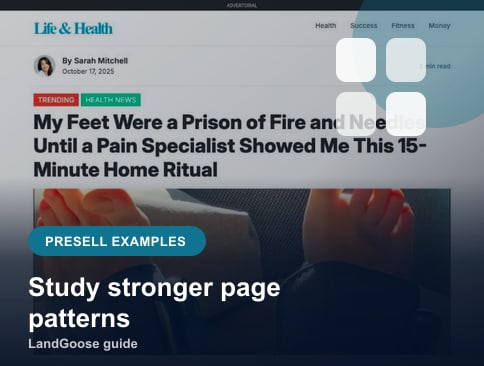
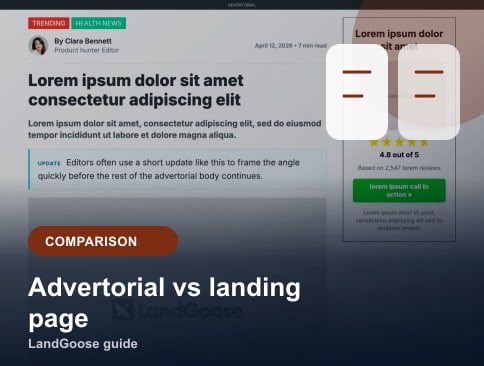
An advertorial builds a persuasive case through narrative, while a listicle organizes the case into numbered, scan-friendly items. Neither format is universally better: the right choice depends on what the reader must understand before clicking to the offer.
Quick Answer
The difference between an advertorial and a listicle is primarily the reading structure.
An advertorial normally develops one continuous argument. It may begin with a problem or story, introduce a discovery or mechanism, add proof, and then present the offer.
A listicle breaks the argument into numbered items. Each reason, tip, mistake, sign, step, or product can be understood on its own, allowing the reader to scan the page before reading in detail.
Both formats can act as pre-sell pages between an ad and a product page, VSL, form, app store, or other destination. Neither format guarantees better results. The correct question is: Which structure helps this reader make the next decision with the least confusion?
Advertorial vs Listicle Comparison
| Decision area | Advertorial | Listicle |
|---|---|---|
| Reading pattern | Continuous narrative | Numbered, scan-friendly items |
| Main strength | Builds context and belief progressively | Makes several points or options easy to compare |
| Typical opening | Story, problem, report, or discovery | Numbered promise such as reasons, tips, or best options |
| Product reveal | Can be delayed until the argument is established | Often appears earlier or inside each item |
| Best content unit | Sections that depend on the previous section | Items that remain useful when scanned separately |
| Common use | One offer that needs explanation | One offer with several reasons or several curated offers |
| Main risk | Slow pacing or excessive length | Repetition, shallow items, or arbitrary rankings |
These are tendencies, not rigid rules. A listicle can contain a story, and an advertorial can contain numbered sections. Classify the page by its dominant reading experience.
What Is an Advertorial?
An advertorial is promotional content presented in an editorial format. Online, it often looks and reads like an article while guiding the reader toward a commercial next step.
Its main advantage is progression. The page can establish a problem, explain why familiar approaches fall short, introduce a mechanism or product, and support the recommendation with relevant evidence.
An advertorial is useful when later sections depend on ideas established earlier. If the reader must understand why the problem happens before the product makes sense, a narrative sequence may be the clearer choice.
For a deeper definition, read what is an advertorial.
What Is a Listicle?
A listicle combines a list with an article. Each item has a heading and enough explanation to add useful context rather than functioning as a bare bullet point.
In performance marketing, common listicle promises include:
- 5 reasons to consider one product
- 7 signs the reader may have a problem
- 6 mistakes to avoid before buying
- 5 things to know about a category
- 8 products for a particular use case
The numbered structure reduces orientation cost. A mobile reader can scan the headings, identify the most relevant item, and still understand the page's core argument.
Explore 12 listicle examples for practical one-offer and multi-offer patterns.
The Difference in Persuasion
Advertorials rely on progression
The reader moves through a sequence. The opening creates relevance, the middle changes or strengthens understanding, and the offer appears after enough context has been built.
This works well when the product is unfamiliar, the mechanism needs explanation, or the audience is skeptical of the category.
Listicles rely on accumulation
Each item adds another reason, criterion, objection answer, or option. The reader does not always need to read every word in order to understand the recommendation.
This works well when the category is familiar, the product has several concrete benefits, or the reader wants a shortlist rather than a long discovery story.
Which Format Fits Different Awareness Levels?
Awareness is more useful than a simple cold-versus-warm rule.
Problem-unaware or lightly aware readers
A narrative advertorial can help establish the problem before asking the reader to compare solutions. A problem-led signs or mistakes listicle can also work if each item teaches rather than merely sells.
Problem-aware readers
Both formats are viable. Use an advertorial when the explanation depends on a mechanism or discovery. Use a listicle when the reader already recognizes the problem and needs several practical reasons to act.
Solution-aware readers
A things-to-know, alternatives, or comparison listicle can make evaluation faster. A review or comparison advertorial may be better when the recommendation requires more context and proof.
Product-aware readers
A direct one-offer reasons listicle may confirm the decision efficiently. A long advertorial may create unnecessary friction unless it adds information the product page does not provide.
Which Format Fits Different Traffic Sources?
Native advertising
Native ads often benefit from an editorial transition. A story, report, discovery advertorial, or problem-led listicle can continue the reading experience without jumping directly into a product grid.
Message match matters more than the label. The first screen should deliver on the idea introduced by the ad.
Meta and social traffic
Mobile scanning makes listicles attractive, especially when the creative promises a defined number of reasons, mistakes, or tips. Advertorials remain useful when the ad introduces a personal story or mechanism that needs a longer explanation.
Search traffic
Higher-intent search visitors may prefer comparisons, reviews, best-product roundups, or direct landing pages. Sending a category-aware reader through a slow discovery story can delay the information they came to find.
Email and retargeting
Warm visitors may need only a short listicle or landing page that confirms key benefits and objections. Repeating a complete cold-traffic advertorial is not always necessary.
One Offer vs Multiple Offers
An advertorial normally centers on one commercial recommendation, even when it discusses alternatives.
A listicle supports two distinct models:
- One Offer: every item strengthens the case for the same product and uses one trusted destination.
- Multi Offer: every item represents a different product or service and must retain its own evidence, image, CTA, and destination.
Do not build a multi-offer page by writing several product names and then sending every button to one generic link. Destination integrity is part of the reader's decision.
Can a Page Be Both an Advertorial and a Listicle?
Yes. "7 Reasons People Are Switching to Product X" can be a listicle and an advertorial at the same time: it is promotional, editorial in tone, and organized as a numbered article.
The overlap is useful, but it should not blur the page plan. Decide whether the reader's experience depends mainly on a continuous narrative or on independent list items. That decision affects drafting, proof placement, images, CTAs, and mobile layout.
How to Decide Which One to Build
Choose an advertorial when:
- the product needs a mechanism or story before it makes sense
- the audience is skeptical and proof must be introduced progressively
- the ad hook opens a narrative that the page should continue
- one conclusion depends on several earlier explanations
Choose a listicle when:
- the promise naturally contains several reasons, tips, signs, or choices
- the reader is likely to scan before reading
- the product has distinct use cases or objections
- multiple offers need separate recommendations and destinations
If both could work, build the simpler credible version of each and test them against the same campaign objective.
How to Test Advertorial vs Listicle
Keep the comparison interpretable:
- use the same traffic source and audience
- keep the core offer and destination stable
- maintain message match with the same ad angle
- verify that both pages make only supported claims
- compare outbound click-through, downstream conversion, revenue or lead quality, and cost per result
Do not declare a winner from page CTR alone. A listicle may produce more outbound clicks but lower-quality sessions, while a longer advertorial may send fewer but better-prepared visitors. Evaluate the complete path.
Building Both Formats in LandGoose
LandGoose keeps both formats inside the same Studio workflow. Choose Advertorial for the classic narrative recipe or Listicle for a structured One Offer or Multi Offer page.
You can review the direction, brief, article, components, destinations, and final preview before generating the page. Start your 7-day trial when you are ready to test the formats with your own offer.
Advertorial vs Listicle FAQ
What is the main difference between an advertorial and a listicle?
An advertorial usually persuades through a continuous editorial narrative, while a listicle organizes the argument into numbered items that readers can scan independently.
Is a listicle a type of advertorial?
A listicle can be an advertorial when it is promotional and written in an editorial style, but listicles can also be non-commercial articles.
Which is better for cold traffic?
Either can work with cold traffic. Choose according to the reader's awareness and information needs, then test both formats with the same offer and comparable traffic.